How To Make Journal Ideas
Finding things to write about in your journal can sometimes feel like searching for a hidden treasure.
I remember staring at blank pages, convinced I had nothing interesting to say, only to discover a wealth of thoughts once I knew where to look.
This guide shares the same practical methods I use to consistently fill my journals with meaningful entries.

Quick Overview
This guide will equip you with a reliable toolkit for generating endless journal ideas.
You will learn practical techniques to tap into your experiences, observations, and inner world, ensuring your journal always has something fresh to explore.
- Time needed: 30-60 minutes (to read and absorb, then ongoing practice)
- Difficulty: Beginner
- What you’ll need: Your journal, a pen, an open mind, and a willingness to explore.
Step-by-Step Instructions
Step 1: Define Your Journal’s Purpose
Before you generate ideas, consider why you journal. Understanding your “why” clarifies what kind of ideas will serve you best.
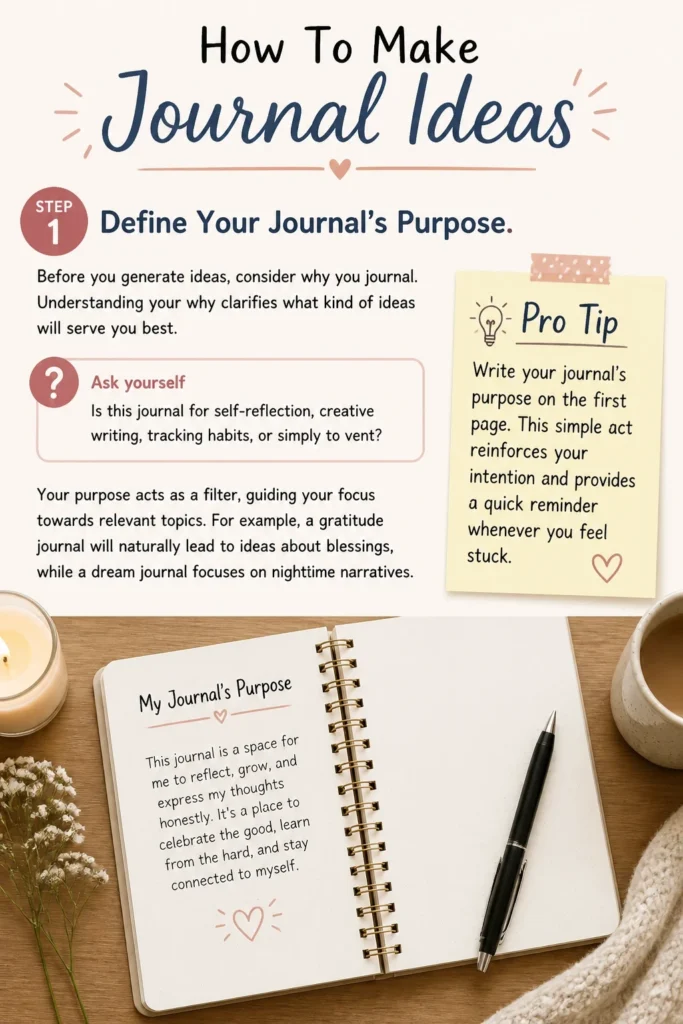
Ask yourself: Is this journal for self-reflection, creative writing, tracking habits, or simply to vent?
Your purpose acts as a filter, guiding your focus towards relevant topics.
For example, a gratitude journal will naturally lead to ideas about blessings, while a dream journal focuses on nighttime narratives.
Pro Tip: Write your journal’s purpose on the first page. This simple act reinforces your intention and provides a quick reminder whenever you feel stuck.
Step 2: Scan Your Immediate Environment
Your surroundings are a rich, often overlooked, source of inspiration. Look around you right now.
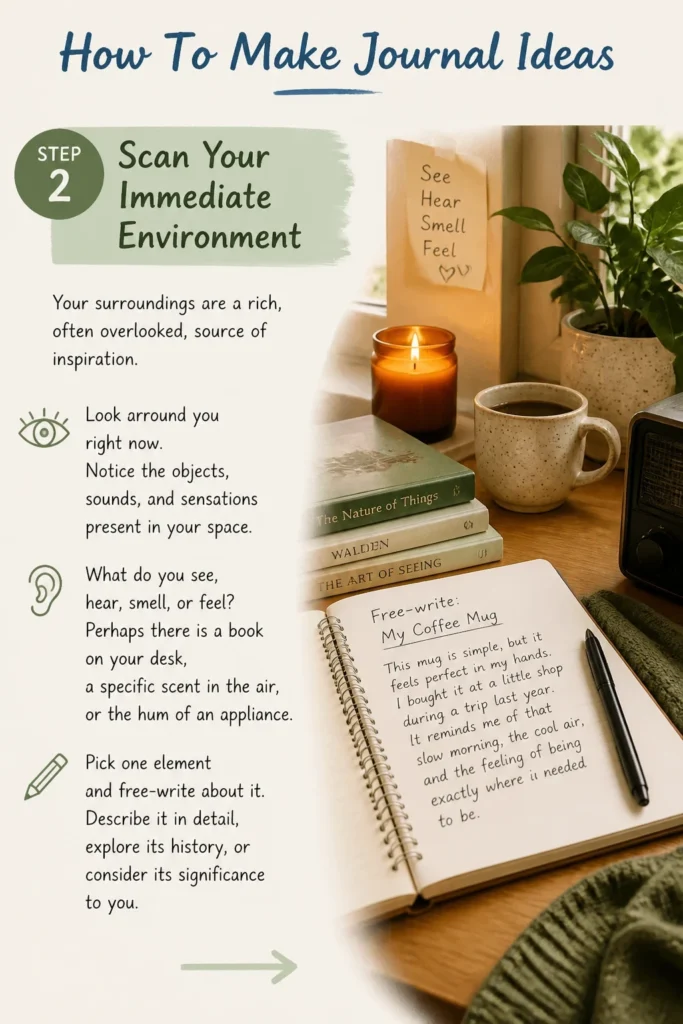
Notice the objects, sounds, and sensations present in your space. What do you see, hear, smell, or feel?
Perhaps there is a book on your desk, a specific scent in the air, or the hum of an appliance.
Pick one element and free-write about it. Describe it in detail, explore its history, or consider its significance to you.
Step 3: Review Your Day’s Events
Every day holds a multitude of small moments worth exploring. You do not need grand adventures to find journal topics.
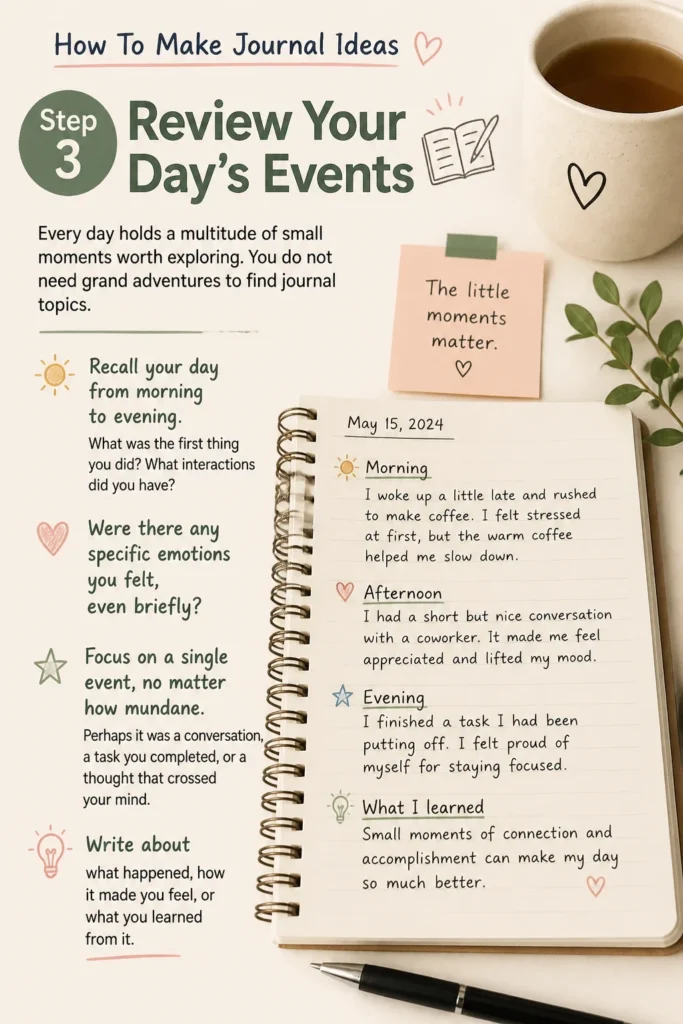
Recall your day from morning to evening. What was the first thing you did?
What interactions did you have? Were there any specific emotions you felt, even briefly?
Focus on a single event, no matter how mundane. Perhaps it was a conversation, a task you completed, or a thought that crossed your mind.
Write about what happened, how it made you feel, or what you learned from it.
Step 4: Engage with Prompts and Questions
Sometimes, a direct question is all you need to spark an idea. Journal prompts are designed to bypass mental blocks.
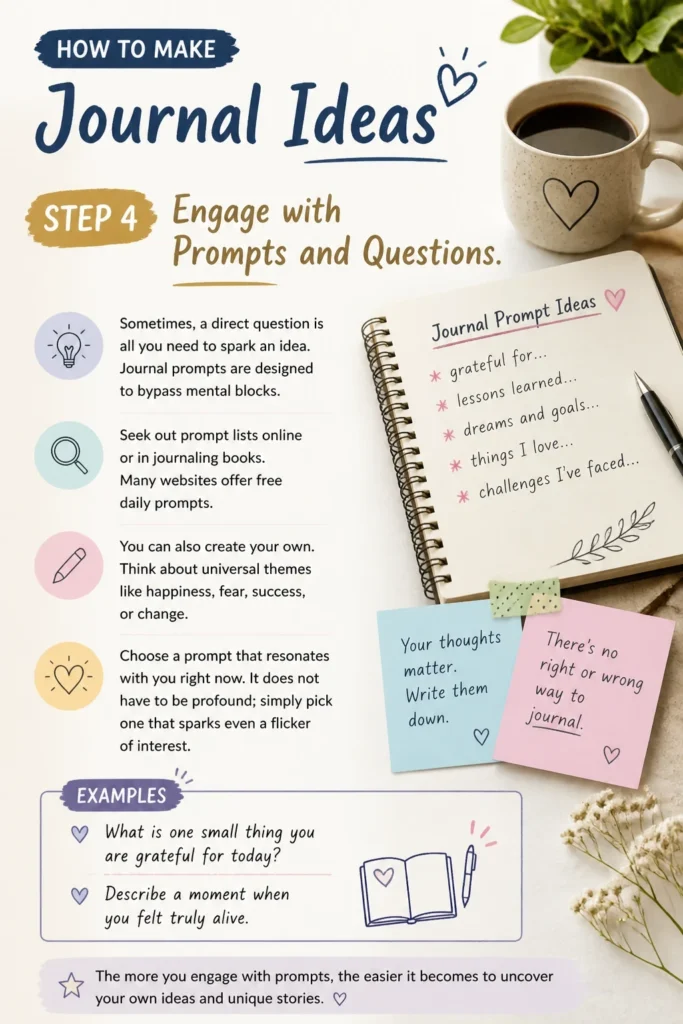
Seek out prompt lists online or in journaling books. Many websites offer free daily prompts.
You can also create your own. Think about universal themes like happiness, fear, success, or change.
Choose a prompt that resonates with you right now. It does not have to be profound; simply pick one that sparks even a flicker of interest.
Examples: “What is one small thing you are grateful for today?” or “Describe a moment when you felt truly alive.”
Step 5: Explore Your Emotions and Sensations
Your inner world is an endless wellspring of journal ideas. Your feelings, thoughts, and physical sensations are always present.

Check in with yourself. What emotion are you experiencing right now?
Is it joy, tiredness, excitement, or mild irritation? Do not judge it; simply acknowledge it.
Write about that emotion. Where do you feel it in your body? What might have triggered it? How does it influence your thoughts?
You can also focus on physical sensations: “My shoulders feel tense,” or “My stomach feels light.” Explore what these sensations communicate.
Step 6: Reflect on Your Dreams and Memories
Dreams and past experiences offer rich, often symbolic, material for journaling. They connect you to your subconscious and personal history.

Recall a recent dream, even a fragmented one. What images, feelings, or narratives stood out?
Do not worry about interpreting it immediately; simply describe what you remember.
Think back to a specific memory. It could be from childhood, last week, or even yesterday. What details can you bring back?
Write about the sights, sounds, smells, and emotions associated with that memory.
Step 7: Observe and Record External Inputs
The world constantly feeds us information and inspiration through various media. Use these as jumping-off points.
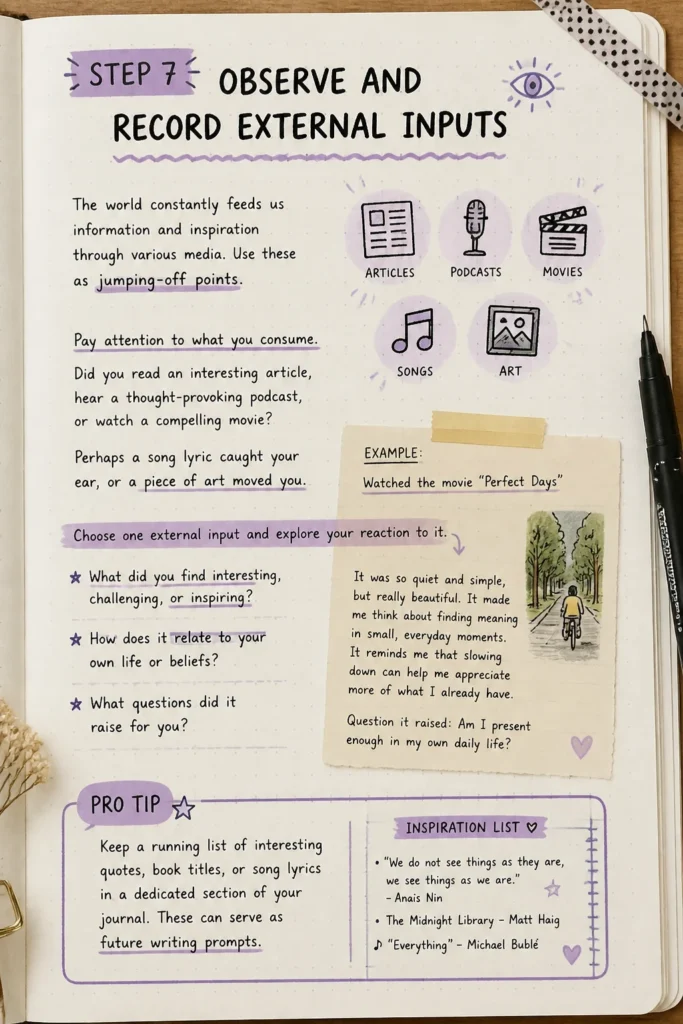
Pay attention to what you consume. Did you read an interesting article, hear a thought-provoking podcast, or watch a compelling movie?
Perhaps a song lyric caught your ear, or a piece of art moved you.
Choose one external input and explore your reaction to it. What did you find interesting, challenging, or inspiring?
How does it relate to your own life or beliefs? What questions did it raise for you?
Pro Tip: Keep a running list of interesting quotes, book titles, or song lyrics in a dedicated section of your journal. These can serve as future writing prompts.
Step 8: Practice “What If” Scenarios and Future Ponderings
Imagination is a powerful tool for generating journal ideas, allowing you to explore possibilities and aspirations.
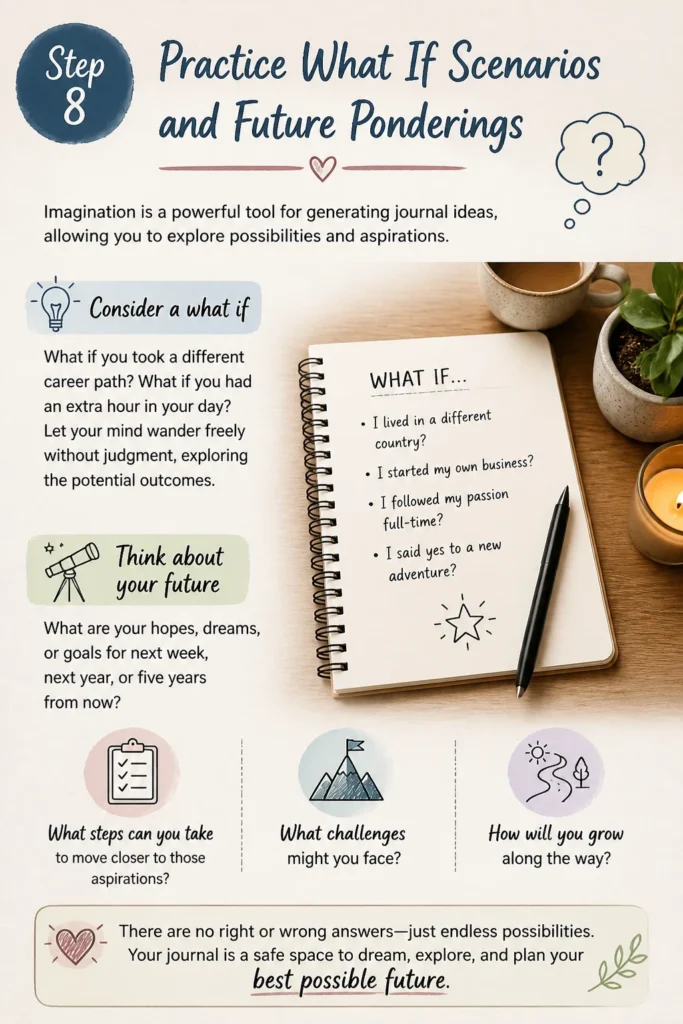
Consider a “what if” question. What if you took a different career path? What if you had an extra hour in your day?
Let your mind wander freely without judgment, exploring the potential outcomes.
Think about your future. What are your hopes, dreams, or goals for next week, next year, or five years from now?
What steps can you take to move closer to those aspirations? What challenges might you face?
Common Mistakes to Avoid
Waiting for Grand Inspiration
Many people believe they need a profound, life-altering event to journal about. This often leads to long periods of not writing at all.
The truth is, consistent journaling thrives on the small, everyday observations and feelings. Do not dismiss the seemingly mundane; it often holds the most personal insights.
Judging Your Ideas Before Writing
It is easy to think an idea is “not good enough” or “boring” before you even put pen to paper. This self-censorship stifles creativity.
Allow yourself to write freely, without editing or criticizing your thoughts. The purpose of journaling is exploration, not perfection. You can always refine or expand later.
Overthinking the “Right” Way to Journal
There is no single correct method for journaling. Some people use bullet points, others write long paragraphs, and some incorporate drawings.
Focusing too much on format or structure can create unnecessary pressure. Experiment with different styles until you find what feels natural and enjoyable for you.
Trying to Force Ideas
When you feel completely blank, trying to force an idea can lead to frustration. Pushing too hard often makes the creative well feel even drier.
Instead, try a different approach: take a short break, change your environment, or simply write about the fact that you have no ideas. Sometimes, that honest admission is the breakthrough.
Troubleshooting
“I feel like I have nothing interesting to say.”
This is a common feeling. Remember that “interesting” is subjective and not the primary goal of journaling. Your journal is for you, not an audience.
Try starting with sensory details. Describe the taste of your morning coffee, the texture of your shirt, or the sound of traffic outside. These small observations can often lead to deeper reflections.
“My entries feel repetitive.”
Repetition can sometimes indicate a core theme or unresolved issue that your mind keeps returning to. Instead of avoiding it, lean into it.
Ask yourself why this particular theme keeps appearing. What new angle can you explore? What new question can you ask about it? Sometimes, writing about the same topic from a fresh perspective can lead to a breakthrough.
“I get stuck after a few sentences.”
This often happens when we try to plan out our writing too much. The goal is to keep the pen moving.
Try a technique called “stream of consciousness” writing. Write down everything that comes to mind, no matter how random or nonsensical. Do not lift your pen from the page for a set amount of time (e.g., 5-10 minutes). This helps bypass the inner critic.
Key Takeaways
- Define your journal’s purpose to guide your idea generation.
- Look for inspiration in your immediate environment and daily life.
- Utilize prompts and questions to overcome mental blocks.
- Explore your emotions, sensations, dreams, and memories for personal insights.
- Engage with external inputs like books, music, and media.
- Embrace “what if” scenarios and future aspirations to spark imagination.
- Do not wait for grand inspiration; everyday moments are valuable.
- Avoid judging your ideas prematurely; simply write them down.
Frequently Asked Questions
How often should I journal to get good ideas?
Consistency is more important than frequency. Even short, daily entries are more effective for generating ideas than long, infrequent sessions. Aim for 5-10 minutes each day, or a few times a week, to build a habit and keep your creative flow open.
What if I write about something private and someone reads it?
Journaling is a personal practice. To protect your privacy, consider using a journal with a lock, storing it in a secure place, or using a digital journal with password protection. The freedom to write honestly depends on feeling safe and uninhibited.
Can I use my journal for different kinds of ideas?
Absolutely. Your journal can be a versatile space. You might dedicate sections to different topics, or simply let it be a free-form collection of all your thoughts, ideas, and observations. The key is to make it work for you.
Is it okay to draw or doodle in my journal instead of writing?
Yes, absolutely. Visual expression is a powerful form of journaling. Doodling, drawing, or even pasting images can be excellent ways to explore ideas, process emotions, and break free from the pressure of always writing words. Your journal is your creative space.
Our Top Recommended Finds
- A sturdy, blank-paged journal: Provides a flexible canvas for both writing and sketching, free from lines that dictate structure.
- A smooth-writing gel pen: Reduces friction and makes the act of writing more enjoyable, encouraging longer sessions.
- A set of colorful highlighters: Useful for color-coding themes, highlighting key insights, or adding visual interest to your entries.
Embrace Your Inner Explorer
Generating journal ideas is not about finding a magical formula; it is about cultivating a curious mindset.
Every day offers a wealth of material if you simply pay attention.
Start small, stay consistent, and trust that your unique perspective is always worth exploring.
Pick up your pen today and begin documenting the rich tapestry of your life.